
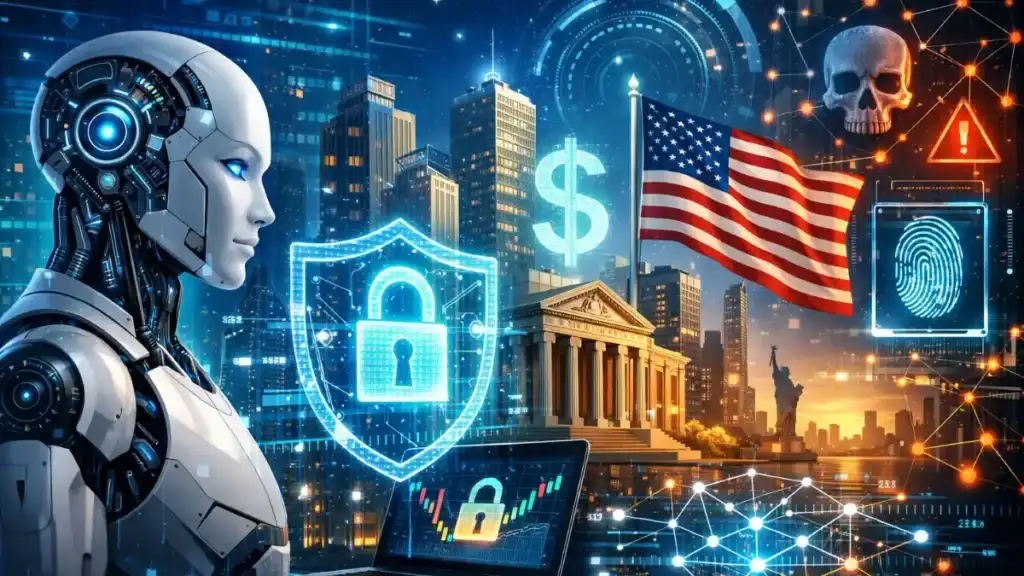
The financial landscape in 2026 is no longer defined by traditional brick-and-mortar security. As digital assets and autonomous systems become the norm, the “battlefield” has shifted entirely to the digital realm. For American banks and investment firms, the implementation of AI Cybersecurity Solutions for Financial Institutions USA is no longer a luxury—it is a foundational requirement for survival.
As cyber threats become more sophisticated, the integration of AI Cybersecurity Solutions for Financial Institutions USA offers a proactive shield against automated attacks that move faster than any human team could track.
1. The 2026 Threat Landscape for US Finance
The current year has seen a dramatic rise in “Agentic AI” threats—malicious bots capable of making independent decisions to bypass legacy firewalls. Traditional rule-based systems are failing to keep up with:
- Hyper-Realistic Phishing: AI-generated deepfake audio and video used to impersonate C-suite executives for unauthorized wire transfers.
- Adaptive Malware: Software that learns from a bank’s defensive posture and mutates its code in real-time to avoid detection.
- API Vulnerabilities: With the expansion of open banking, unsecured entry points have become the primary target for data exfiltration.
To counter these, the adoption of AI Cybersecurity Solutions for Financial Institutions USA has shifted from experimental pilots to enterprise-wide deployment.
2. Key Pillars of AI-Driven Defense
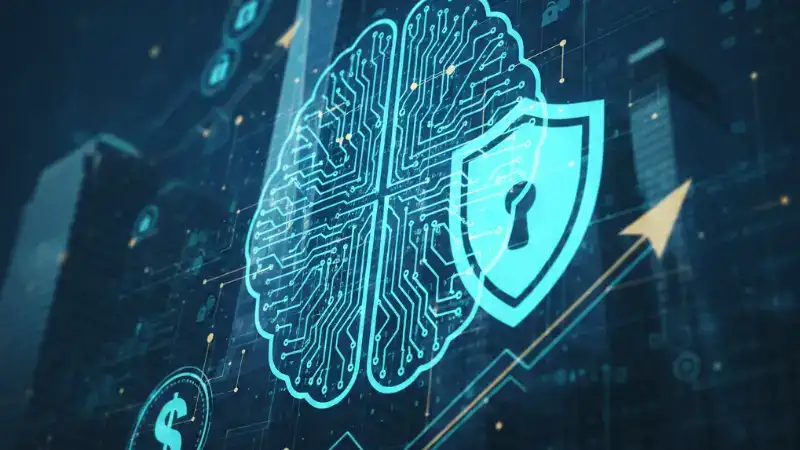
Modern financial security relies on three core technological pillars that define the current generation of AI Cybersecurity Solutions for Financial Institutions USA:
Behavioral Biometrics and Identity Intelligence
Instead of relying solely on passwords, AI now monitors user behavior—typing speed, mouse movements, and even gait (via mobile sensors). If a user’s behavior deviates from their established pattern, the AI triggers an immediate MFA (Multi-Factor Authentication) challenge.
Real-Time Fraud Detection (RTFD)
In 2026, banks are processing millions of transactions per second. AI models analyze these in milliseconds, identifying “synthetic identities” and money laundering patterns that would be invisible to human auditors.
Automated Incident Response
When a breach is detected, the AI doesn’t wait for a human operator. It can autonomously isolate compromised endpoints, block malicious IP addresses, and roll back unauthorized system changes, reducing “dwell time” from days to seconds
3. Regulatory Compliance and the “GENIUS” Act
Compliance in the USA has become more stringent. The U.S. Treasury recently released the Financial Services AI Risk Management Framework, which mandates that any AI Cybersecurity Solutions for Financial Institutions USA must be “explainable.” This means banks must be able to prove why an AI made a specific security decision to avoid algorithmic bias or “black box” errors.
| Feature | Legacy Security | AI Cybersecurity Solutions for Financial Institutions USA |
|---|---|---|
| Detection Speed | Reactive (Minutes to Hours) | Predictive (Milliseconds) |
| Analysis Method | Manual & Rule-based | Autonomous & Behavioral |
| Scalability | High Labor Cost & Human Dependency | High Efficiency & Machine Learning |
| Threat Response | Static / Signature-based | Dynamic / Adaptive |
| Accuracy | Prone to False Positives | Precision Context-Aware Filtering |
4. Looking Ahead: The Future of Cyber Resilience
The “arms race” between hackers and defenders is intensifying. By the end of 2026, it is projected that over 90% of US mid-size and large banks will have fully integrated AI Cybersecurity Solutions for Financial Institutions USA into their core infrastructure.
The goal is no longer just “blocking” attacks, but building Cyber Resilience—the ability to operate through an attack and recover instantly. As we move into 2027, the focus will shift toward “Quantum-Resistant” AI to protect against the next generation of computing threats.
Future of Cyber Resilience
By the end of 2026, it is projected that over 90% of US mid-size and large banks will have fully integrated AI Cybersecurity Solutions for Financial Institutions USA into their core infrastructure to ensure total operational resilience.